When I was in grad school at Georgia Tech, I was required to take a class where we programmed in Java. Just as no one would ever accuse me of being an athlete, I am not a natural developer either. Learning Java felt like learning to communicate without a tongue. I cried a few times, designed and developed a few simple games, and eventually passed the class. However, there was one project that I loved.
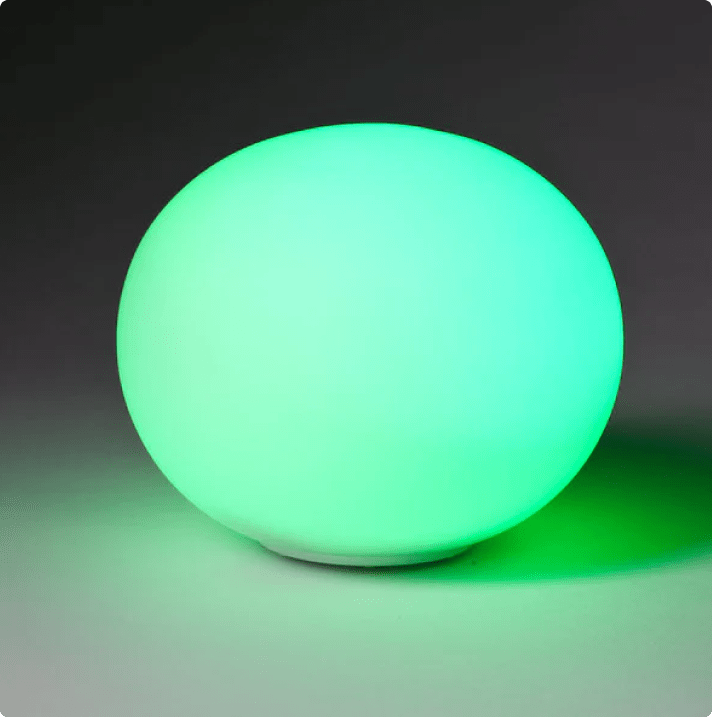
We were given an ambient orb to program. The ambient orb looks like a crystal ball. And like a crystal ball, it glowed to display information. Fastened with a simple LED, it could change color depending on what you programmed it to do. The most common example is the stock exchange. If the market is going well, the orb glows emerald green. If the market tanks, it deepens to red. I loved the simplicity and the potential of this product. It felt magical. A way of turning invisible information into something tangible. This was my first experience with ambient technology.
Fast forward to now, and it seems commonplace for households to have one or more ambient technologies. Far from the simple ambient orb, these systems are equipped with multiple sensors and sophisticated logic. From the smart speaker you chat with to set kitchen timers to wearables that monitor your biometrics to help you meet health goals, these devices offer rich functionality but are largely passive in how we interact with them. Equipped with sensors, these devices anticipate our needs, react to our environment, and are largely low- or no-screen. They exist in the background of our lives and perk up at our need or our prompting. It’s a more humane interaction than the reactive, attention-hogging screen that demands tapping and clicking.
Ambient technology has been around for a while. But our most recent home and commercial uses are very pragmatic. They lack some of the surprise and delight that make ambient technologies interesting. The history of these devices embraced whimsy as part of their ethos. It’s worth a review for inspiration today.
A Short History
Calm Technology (1995 – present)
Visionary Mark Weiser was the CTO at Xerox PARC. He’s credited with coining the term “ubiquitous computing” in 1988, a philosophy in which invisible computers are embedded in everyday objects. It’s the basis of ambient technology. He and fellow visionary John Seely Brown wrote a paper about designing calm technology. In it, they describe a vision for technology that lives in the periphery of our attention rather than demanding it. In contrast to devices designed to grab us with beeps, buzzes, and push notifications, calm technologies don’t overload us with information.
They explored concepts that sound more like art than product design. They collaborated with artist Natalie Jeremijenko to create a piece called the “Dangling String.” Basically, a string dangling from a drop ceiling tile, connected to a motor that sensed network traffic. The faster the traffic moved, the more the cord jiggled. A small sign jokingly read “live wire.” It made invisible data visible. Weiser himself created a fountain outside Xerox PARC whose flow fluctuated with the stock market. Imagine the dramatic geyser a bullish spike would produce.
Amber Case, a cyborg anthropologist, has focused her career on Calm Technology. She founded the Calm Tech Institute and has written several books on the topic. Her 8 principles are a useful design lens:
Require the smallest possible amount of attention
Inform and create calm
Make use of the periphery
Amplify the best of technology and the best of humanity
Communicate without speaking
Still work when it fails
Use the minimum technology needed to solve the problem
Respect social norms
Principle 6, Still work when it fails, is particularly striking. A phone without a working battery becomes a hunk of glass and metal. Calm technology, by contrast, is designed to remain useful even when the sophisticated parts fail.
Enchanted Objects (2002-2008)
In the early 2000s, David Rose, a scientist at MIT Media Lab, co-founded Ambient Devices. The premise was to take everyday objects and use technology to make them magical. As Rose summarized in his TED talk, “Enchanted objects are ordinary things made extraordinary.”
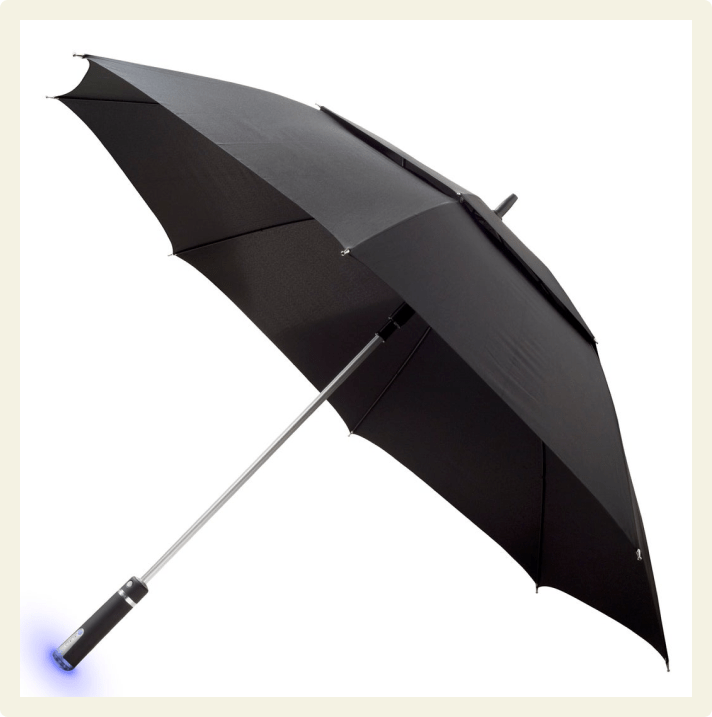
Rose’s most famous invention was the Ambient Orb, the same device I programmed at Georgia Tech. But the company created many others: the Ambient Umbrella, an internet-connected umbrella whose handle glows when the weather requires it; a wallet that physically tightens as you approach your budget; the GlowCap, a pill bottle that alerts you if you haven’t taken your medication. Ambient Devices transformed regular objects into ones that delight and communicate through light, sound, and subtle physical changes.
In his book Enchanted Objects, Rose defines 7 design traits that differentiate these devices from phones or apps. Together, they describe what an encounter with an enchanted object should feel like:
Glanceability – Information communicated at a glance through changes in color, light, or sound.
Gestureability – Responds to natural, intuitive gestures we already know: a toss, a wave, a tap.
Affordability – The physical shape, texture, and materials communicate function clearly.
Wearability – Integrated into things we already wear or carry, like jewelry or accessories.
Indestructibility – Built to resist daily wear and tear.
Usability – Interaction is frictionless and intuitive.
Loveability – The object connects emotionally with the user. It becomes cherished.
When you review the principles from both Calm Technology and Enchanted Objects, a consistent thread emerges: the best ambient technology communicates simply and earns a place in our lives without demanding attention. Most of these principles ladder up to one idea: technology that respects its context.
Looking forward
AI has introduced a new layer of possibilities into ambient devices. Voice interfaces, predictive systems, and always-on sensors are increasingly available to us. It’s reminiscent of Weiser’s vision for ubiquitous computing. But they aren’t always great at staying in the periphery, and the usability is far from frictionless. Our context and intent remain difficult to communicate, and smart devices fail all the time, resulting in frustrating and unpredictable outcomes. You’ve probably experienced checking your smart speaker for a timer, only to discover it was canceled inexplicably. Or taking your smartwatch or wearable off your wrist because it was alerting you aggressively when you didn’t want it to.
In designing the next batch of smart, AI-enabled devices, it’s worth reflecting on and borrowing from the frameworks of Calm Technology and Enchanted Objects. Ask ourselves:
Does this require the least possible attention, or are we adding to the noise?
Does the interaction feel like something the user already knows how to do, or are we asking them to learn a new behavior?
Does the object or interface still provide value when the sophisticated parts fail?
Would a user choose to keep this in their life? Is it a cherished object?
We’ve spent years figuring out how to make screens more engaging and usable. Designing for ambient devices is a different challenge entirely. The goal is to live in the periphery, use context to provide relevance, and stay out of the way. But maybe we should also design in some of the surprise and delight that make the Ambient Umbrella and GlowCap so memorable. Blend utility and whimsy to create objects people cherish and would choose to live with.
AI can generate more design options faster than any designer working alone. What it can’t do is know which options belong in your product. A look at a workflow that uses AI where it’s strongest and reserves the hardest thinking for the designer.
AI tools are blurring traditional design process roles. While we’re speeding up workflows and broadening our skills, we still need to consider the small details that make designs worth loving.
AI is transforming how we live, work, and communicate. With AI’s help, we can move from idea to product launch at super-speed. Never before have we been able to move