There’s a buzz and a blur happening. Product teams everywhere are seeing a revolution that I like to call the big smoosh. The big smoosh is where the roles of product, design, development, project management, and content merge. You see this when AI empowers a product manager to create a working prototype to convey requirements in an afternoon. Or when a designer makes marketing copy on the fly and pops it into their clickable prototype. Or when a developer creates new design components for a dashboard and tests them that same day. Tasks that used to be distinct and require years of training and specialized tools now collapse into the work of one person with a good set of prompts and patience.
The Wall Street Journal recently captured the cultural shift: Suddenly Everyone in San Francisco Is a ‘Builder,’ Whatever That Means. This is bigger than San Francisco. With AI and no-code tools, making products is easier than ever. If you can describe it (or prompt it), you can build it.
AI enabled this smoosh. It’s helped us break out of our boxes. It sharpens where we are dull, it speeds us up where we are slow, and it unlocks opportunities we didn’t think were possible.
I’m all in. I’ve built a few apps for things no one else would want, such as the app that tracks my dog’s bathroom breaks. AI lets me design, PM, and build these apps myself, work I would previously have had to outsource (or never build at all).
The devil in the details
It’s great that we can move faster and without constraints, but I keep wondering: what is being lost in the process?
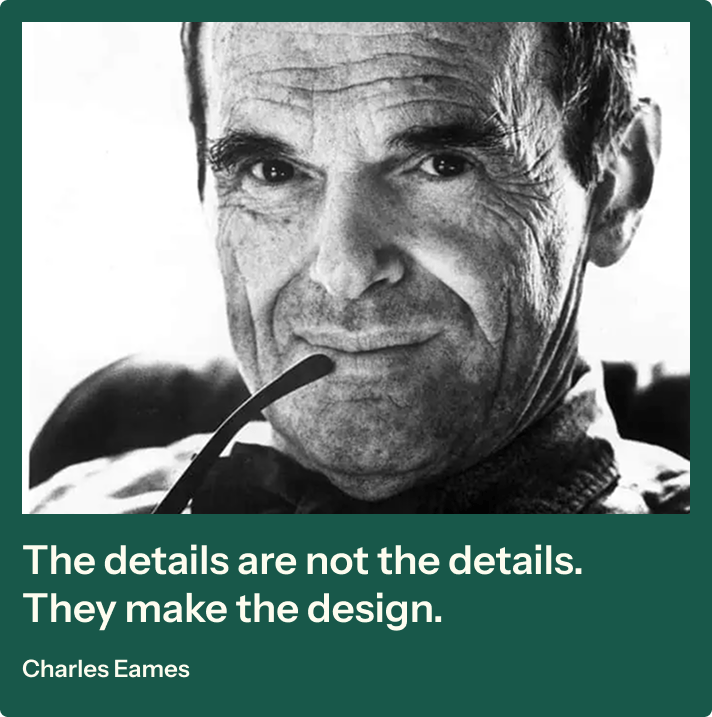
There’s a quote I love by Charles Eames, the designer and half of the Charles and Ray Eames duo. “The details are not the details. They make the design.”
Source: St. Louis Walk of Fame
This quote resonates with me because it gives voice to the things in a design that I love. It’s the taper of the ring shank that makes it more wearable. It’s the way the mug handle is sculpted to balance perfectly in your hand. And it’s how the hallway opens into an unexpectedly vast room that takes your breath away. These are the moments you may not even notice, but they make a huge difference in how you experience a product. These details create the experience in digital products, too. We see it on a website with the icons and bullet points that perfectly answer your question without overwhelming you. It’s the empty state that teaches you what to do. And it’s the celebration moment you didn’t expect, one that creates a sense of completion. These are the details that make the design good.t
As a culture, we tend to downplay details. Details are inconvenient. Details are small. They aren’t the main problem, and they certainly can wait until we have time for them. However, it’s these details that make the experience memorable and pleasurable. My fear is that these design details aren’t being cultivated in the AI smoosh.
Pushing for design details
The allure and power of AI is that it can quickly manufacture an experience that feels real and polished. And the risk in that polished design is that it can feel like it’s done. While it’s tempting to call it complete, in reality, it’s a starting place, a rough direction missing the details that resonate.
So how do we get to the good details that resonate?
From my experience, the details emerge from iteration. It’s part of the art of the design process, and what inspires those details is different for everyone, shaped by what you value. I can’t give you a step-by-step guide. For me, it comes down to how someone uses the product. I find the details that matter by watching people and asking why. Take the mug. If we see that people keep dropping their mugs, we need to dig in and find out why. Is it because the mug has the handle in the wrong place? Are people holding it wrong? What are they doing right before the mug drops? What can we adjust about the mug to guide them to the right grip?
This is where design shines. Designers look for the details that matter and make sure they show up in the final product. Without a designer watching for opportunities to refine these details, we risk putting out products that are just okay, ones that don’t speak to the user and definitely don’t bring people back.
Design in the AI smoosh
The big smoosh stretches our abilities wider, but not deeper. In that widening, expertise gets diluted.
When you think about the products you love, it’s the details that make them memorable. The details are not the details. They make the design. And in the age of AI, someone still has to push for them.
AI can generate more design options faster than any designer working alone. What it can’t do is know which options belong in your product. A look at a workflow that uses AI where it’s strongest and reserves the hardest thinking for the designer.
AI is transforming how we live, work, and communicate. With AI’s help, we can move from idea to product launch at super-speed. Never before have we been able to move