AI is transforming how we live, work, and communicate. With AI’s help, we can move from idea to product launch at super-speed. Never before have we been able to move this quickly! Is it awesome? Scary? Both? What scares me is something I’m starting to see in design reviews. In an effort to speed things up, there’s a tendency to offload product thinking and let AI do it for us. How we use AI in the design process matters; there are ways to integrate AI without losing the details that differentiate your product.
There’s a temptation to use AI to think for us, design for us, and create the user experience for us. It’s scary because if we do this, we lose details that make experiences great! The thoughtfulness of an experience, the details that solve a user’s need, and the unique differentiators that define products and help them stand out.
AI is a tool to amplify what you feed it. Not a replacement for our thinking.
AI can create generic products that appear polished on the surface but fail to solve real user problems deeply, or (my favorite word) AI slop. If designers and product managers skip the foundational work of following a structured design process, AI will simply help you build the wrong thing…faster.
At Everyday, we’ve worked with client teams for over 13 years, and I’d like to highlight some of the tips we’ve learned to incorporate AI without skipping the essential parts of the process. I believe that AI shouldn’t replace the design process, but transform how design is done.
Why the design process is still important
The power of the design process lies in its ability to cultivate your thinking. It helps you and your team navigate uncertainty, refine your thinking, and learn from your customers. It’s the foundation for building something worthwhile and standing out from the competition.
Steps of the design process
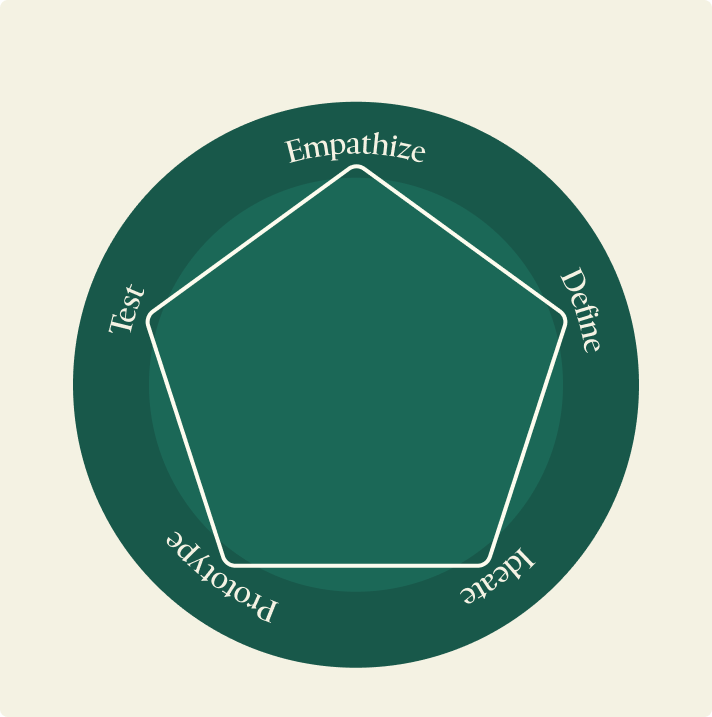
The steps of the design process are well documented in so many places, but here is the basic framework:
Empathize: Using research, build context to understand the needs and behaviors of your customers
Define: Organize your data and articulate the core issue you are trying to solve
Ideate: Brainstorm and create possible solutions
Prototype: Create a vision of the product that can be used in testing
Test: Have users give feedback on the prototype to learn where the concept can be refined.
Where AI Fits In
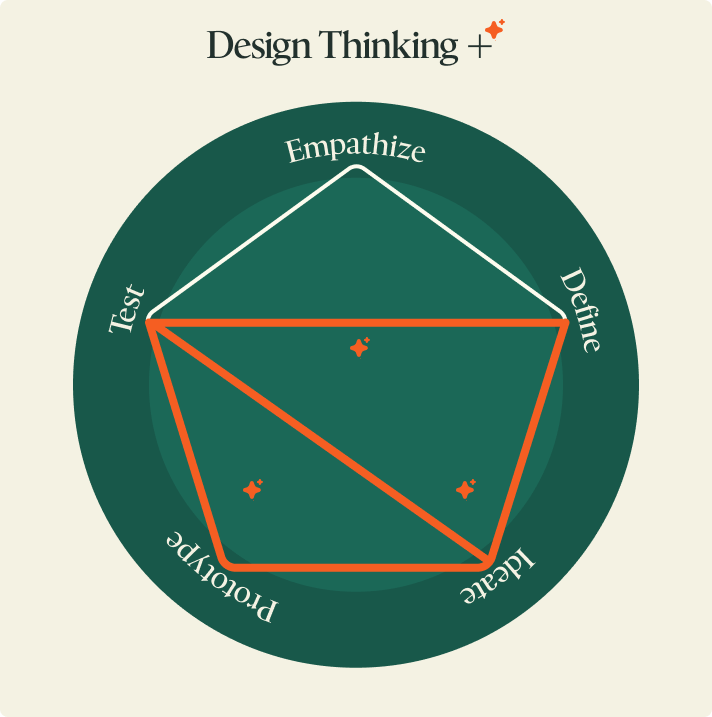
Ok, let’s talk about where AI fits in. AI’s power is in execution, optimization, and pattern recognition. It removes some of the grunt work from your plate. But it struggles with some of the nuanced, contextual thinking that makes great products truly great.
Here’s how to use AI strategically within your design process. Let’s work smarter, not… You got it.
1. Empathize
Offload laborious research tasks. In the Dark Ages, we required a transcriber for every interview to document conversations and summarize the notes. This laborious process is drastically shortened with AI tools. We only need the interviewer while the AI transcribes in real-time. Be cautious if you need HIPAA compliance (more on that later).
2. Define
Find patterns faster. Turn that data into something you can use. Upload large datasets, user interviews, reviews, and support tickets. AI can help generate patterns and initial research. You’ll use these patterns to find insights. Not all of them are great. You’ll need to repeat this process several times to identify the correct patterns. But it’s a start! This is an assist, not a replacement for you.
Pull quotes and examples. Sometimes you need to pull example quotes to help tell the story. This can be so tedious! But now AI can help you sift through the data to find the quote you are looking for faster than lightning.
3. Ideate
Your collaborator. We sometimes use AI to bounce ideas off of. Using different scenarios or user segments as prompts, AI can generate alternate concepts you may not have considered.
Your critic. Treat AI as another “eye” to speed up concept creation. Upload your initial concepts and ask for feedback. Sometimes they have a point.
4. Prototype
Generate placeholder content. I often say, “I’m not a copywriter, but I play one in UX.” For our concepts, we create initial copy to convey the intended message, but then we wait for a professional copywriter to refine it. With AI, we can quickly elevate our placeholder content to a much higher level. We write in bullets the intent, and have AI refine it as we provide more context and feedback.
Prototype quickly. Quickly build something that feels real and can be tested with users. We primarily use Figma, which allows us to easily link screens together, making the experience feel more realistic. Numerous tools are available that help you create prototypes directly from the files themselves.
5. Test
Research assistant / PM. Use AI to transcribe user feedback, organize your data, and compile your to-do items for refinement.
Now, onto where you need to rely on your powers of design thinking. My mantra here is that AI is a powerful tool, but it should be used as a collaborator, not a replacement for your thinking. Here’s where AI falls short, and where your unique insights and understanding come into play.
Creating a seamless UX While AI can help expand your concepting, it can’t make a seamless UX. It lacks the strategy involved in using consistent interaction paradigms or the subtlety of designing for a specific audience. Please don’t let it design for you.
Deep user empathy While AI excels at organizing patterns, it struggles with subtlety. It can’t pick up on the hesitation of a user when evaluating a website, or subtle frustration in their voice that reveals unmet needs. This kind of contextual understanding helps define great products.
Generating deep, relevant insights As I mentioned earlier, AI excels at pattern recognition. But those patterns aren’t insights. We need to take those patterns and connect them to how they ladder up to bigger ideas. It takes a human to answer what it means for your business strategy. Or what impact it might have on the product, and how you want customers to interact with it.
Applied context AI might miss nuances such as cultural nuances, emotional triggers, or the broader context that influences user behavior. Human designers understand the difference between what people say they want and what they actually need.
AI is a tool, but you design the experience
AI is the tool in your design kit to improve your design, but well-designed experiences must be grounded in solid design thinking and a genuine understanding of the user. Relying too heavily on AI can lead to missed insights that differentiate your product. Use AI to speed up your process, but do not let it replace your critical thinking.
AI is trained to be generic. Don’t make generic products.
AI can generate more design options faster than any designer working alone. What it can’t do is know which options belong in your product. A look at a workflow that uses AI where it’s strongest and reserves the hardest thinking for the designer.
AI tools are blurring traditional design process roles. While we’re speeding up workflows and broadening our skills, we still need to consider the small details that make designs worth loving.